
Australia is accelerating its shift toward renewable energy, with solar power leading the charge. Thanks to its sunny climate and falling installation costs, more households and businesses are embracing solar than ever before. One of the biggest drivers behind this rapid adoption is the range of solar power government incentives available across the country. These rebates not only make solar systems more affordable but also encourage Australians to take a step toward cleaner and more sustainable energy solutions.
In 2025, the government rebate for solar power continues to play a vital role in reducing upfront costs and improving long-term savings on electricity bills. Whether you’re a homeowner or a business, understanding these rebates can help you maximise your return on investment. This guide explores the key solar rebates available across Australia’s states and territories in 2025.
What Are Solar Power Government Rebates?
Solar power government rebates are financial incentives offered to make solar energy more affordable for households and businesses. These rebates, subsidies, and incentives reduce the upfront installation cost, helping more Australians switch to clean energy.
There are two main types of support available: federal incentives and state-specific programs. Federal schemes, such as the Small-Scale Renewable Energy Scheme (SRES), provide Small-Scale Technology Certificates (STCs) that lower the cost of solar panels nationwide. In addition, each state offers its rebates tailored to local needs. For example, New South Wales, Victoria, and Queensland provide extra savings, while other states offer loans or feed-in tariffs to encourage adoption.
These home solar power government rebates and business solar power government rebates play a vital role in making solar more accessible. By cutting upfront expenses, they allow homeowners to enjoy lower power bills and help businesses reduce operating costs while achieving sustainability goals.
Also Read: Solar Power Rebate Australia: Your Complete Guide to Saving Big
Federal Solar Power Incentives in 2025
In 2025, Australia’s Small-scale Renewable Energy Scheme (SRES) continues to offer strong incentives for small-scale solar, wind, hydro, air-source heat pumps, and solar water heaters Clean Energy Regulator. Under this program, you earn Small-scale Technology Certificates (STCs) — each STC equals 1 MWh of renewable energy generated, stored, or displaced Clean Energy Regulator. These certificates can be sold or assigned—typically via your installer—to reduce upfront system costs.
2025 updates: Starting 1 July 2025, solar batteries (5–100 kWh) became eligible for STCs under the expanded SRES Clean Energy Regulator. Under the new Cheaper Home Batteries Program, the government now purchases these STCs (around $40 each) to provide a ~30% discount, preventing battery costs from being passed onto all energy consumers.
Benefits: Both homeowners and businesses save substantially—via upfront solar system discounts or reduced battery costs. Plus, the scheme boosts energy independence, lowers bills, and encourages a cleaner grid.
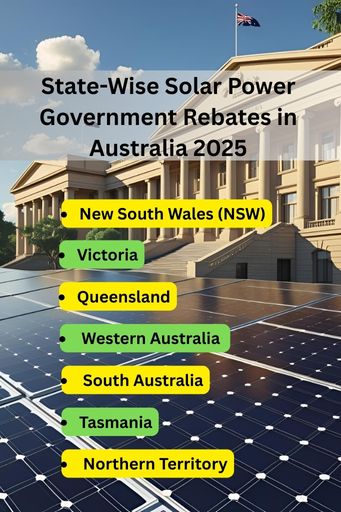
State-Wise Solar Power Government Rebates in Australia 2025
Solar Power Government Rebate New South Wales (NSW)
New South Wales solar rebates in 2025 combine the federal Small-scale Renewable Energy Scheme (SRES) and state battery incentives with interest-free loans. The NSW Peak Demand Reduction Scheme ended on 30 June 2025, but Virtual Power Plant (VPP) incentives remain, offering up to $1,500 for connecting batteries. These can be stacked with the new federal Cheaper Home Batteries Program, offering around a 30 % discount on battery cost.
Solar Power Government Rebate Victoria
Victoria’s Solar Homes Program continues in 2025, offering rebates of up to approximately $1,400 toward solar PV systems, alongside interest-free loans for eligible households and businesses. Victorian residents also benefit from the federal SRES rebate and the national Cheaper Home Batteries Program with a 30 % upfront discount on new battery installations.
Solar Power Government Rebate Queensland
Queensland offers solar incentives, including the federal SRES rebate and emerging schemes such as community solar banks in regions like Townsville and Caloundra. Feed-in tariffs remain for exporting surplus electricity. Businesses in Brisbane can also apply for local sustainability grants to support solar adoption and upgrades.
Solar Power Government Rebate Western Australia (WA)
In Western Australia, solar rebates include federal SRES benefits plus a state Home Battery Scheme—offering up to $3,800 for Horizon Power customers or $1,300 for Synergy customers, with interest-free loans up to $10,000. These can be stacked with the federal Cheaper Home Batteries Program (approx. 30 % discount) pending VPP participation.
Solar Power Government Rebate South Australia (SA)
South Australia continues to lead with strong incentives: the federal SRES rebate, feed-in tariffs, and state/local council subsidies such as 20 % off shared solar installations (up to $20,000 per site). The Cheaper Home Batteries Program (30 % rebate) also applies from July 2025 across SA.
Solar Power Government Rebate Tasmania
Tasmania offers federal SRES incentives and the national 30 % Cheaper Home Batteries rebate. Although the Tasmanian government currently does not offer additional solar or battery rebates, interest-free energy saver loans up to $10,000 are available for energy efficiency projects, including solar and storage.
Solar Power Government Rebate Northern Territory
In the Northern Territory, federal SRES rebates and the Cheaper Home Batteries Program apply, though the NT Home and Business Battery Scheme has reached its funding cap—state rebates are no longer available. Eligible homeowners and businesses rely on federal support for solar and battery installations.
Solar Power Government Rebate, Australian Capital Territory (ACT)
The ACT offers robust support, including federal SRES rebates, the national 30 % battery discount, plus the Sustainable Household Scheme, providing zero-interest loans up to $15,000 for solar panels, batteries, EV chargers, and other upgrades. The Home Energy Support scheme also provides rebates up to $2,500 for energy efficiency projects.
From 1 July 2025, the federal Cheaper Home Batteries rebate reduces eligible battery costs by ~30% upfront and is stackable with some state/retailer programs — a major shift that improves paybacks nationwide.
Home vs Business Solar Rebates – What’s the Difference?
When it comes to going solar, both households and businesses in Australia can take advantage of government support. Home solar power government rebates are mainly designed to reduce upfront installation costs for families, making solar more affordable and helping households cut energy bills.
On the other hand, business solar power government rebates target small and medium enterprises (SMEs). These rebates often cover larger system sizes and may include additional incentives such as grants or low-interest loans. Unlike households, businesses can also access tax deductions and accelerated depreciation, making the switch to solar a smart financial move.
Overall, while both groups benefit from lower costs and sustainable energy, businesses enjoy added tax perks and stronger long-term ROI.
| Category | Homeowners | Businesses |
|---|---|---|
Upfront Savings | Rebates | Rebates + Grants |
Tax Benefits | Limited | Deductions |
ROI | Medium | High (long-term) |

Tips to Maximize Your Solar Power Government Rebates
Government rebates for solar power are a great way to reduce the upfront cost of installing solar panels. To make the most of these incentives, it’s important to apply early, as rebate programs often have limited funding and can close once allocations are exhausted. Choosing accredited solar installers is another key step, since many rebate schemes only recognize certified providers, ensuring both quality and compliance.
For even greater savings, combine your solar rebates with feed-in tariffs, which allow you to earn credits for the excess energy you send back to the grid. Finally, always check and follow the eligibility criteria and scheme guidelines carefully—missing a requirement could result in losing your rebate. With the right approach, homeowners and businesses can maximize their solar power government rebates and enjoy long-term energy savings.
Reviews & Real-Life Impact
Across Australia, countless households are experiencing the real benefits of solar power. Families in Sydney and Melbourne report saving hundreds of dollars annually on electricity bills, while small businesses in Queensland and South Australia cut operating costs by switching to solar energy. These success stories highlight not only the financial savings but also the growing confidence in renewable solutions.
Beyond individual gains, solar adoption directly contributes to Australia’s renewable energy targets, reducing carbon emissions and promoting energy independence. Real-life results build trust, showing Australians that investing in solar is not just an eco-friendly choice—it’s a practical step towards long-term savings and a sustainable future.
Also Read: Top Solar Power Companies in Australia: Reviews, Costs & Insights
Conclusion
In 2025, government rebates continue to make solar power one of the most affordable and rewarding energy solutions for Australian households, Solar Power Government Rebate in Australia 2025 LDS, and businesses. With generous incentives available across states, going solar not only reduces electricity bills but also contributes to a greener future.
However, these rebates can vary depending on your location, and they may change or phase out over time. That’s why it’s essential to check your state’s eligibility and act quickly. By investing in solar today, you can secure the maximum rebate benefits while enjoying long-term savings and energy independence. Don’t wait—make the switch to solar now.

Solarmee.com empowers homeowners, businesses, and installers with clear, expert solar guides, product insights, and Learn how to make smarter solar decisions.